
Door Hanger Printing for Dental and Medical Practices
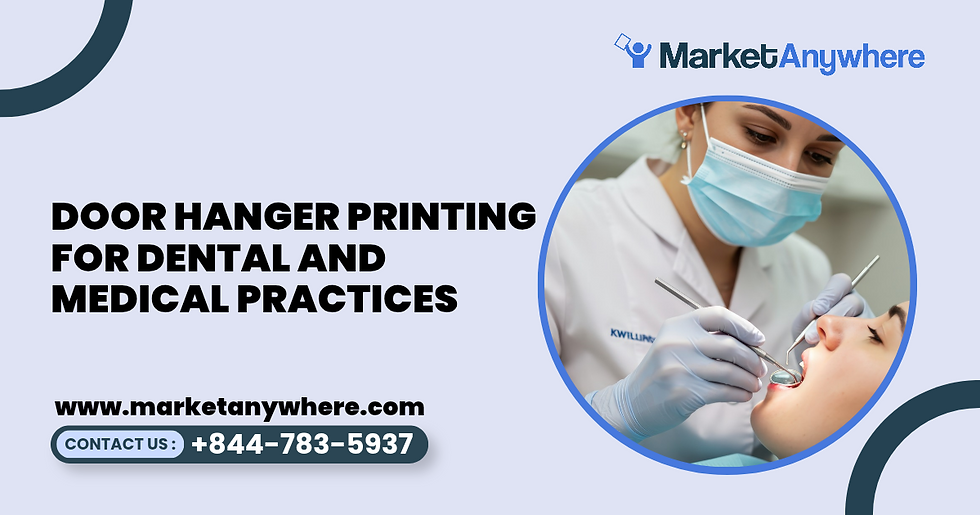
Dental and medical practices need practical ways to introduce their services, communicate important office information, and reach people in their surrounding communities. Door hanger printing offers a way to announce a new practice location, share general information about routine services, and make appointment details easy to find. With clear messaging, privacy-conscious design, and accurate information, printed door hangers can support a healthcare practice's local outreach efforts.
Unlike materials designed for lengthy explanations, door hangers have limited space. Dental offices, medical clinics, and other healthcare providers must prioritize the information that matters most to local residents. A well-planned campaign can introduce the practice, explain how to contact the office, and direct interested readers to an appropriate source for additional information.
Why Dental and Medical Practices Use Door Hanger Printing
For healthcare practices, local awareness is an important part of introducing services to a community. Residents may not know that a new dental office has opened nearby or that an existing medical practice offers particular routine services.
Printed door hangers provide a physical format for communicating this information to households in a selected area. They can complement a practice's website, online listings, and other community outreach activities.
Healthcare practices can use door hangers to:
Announce the opening of a new office or clinic.
Introduce an existing practice to nearby residents.
Share general information about routine services.
Communicate office hours and contact details.
Explain how to request or schedule an appointment.
Direct readers to a website with more detailed information.
Promote general awareness of the practice within its local community.
The message should reflect the practice's actual services and the information residents need. A dental office may emphasize routine dental services, while a general medical clinic may focus on its location, operating hours, and appointment process.
The purpose is to make essential information accessible without turning a small printed piece into a complicated medical brochure.
1. Announce a New Dental or Medical Practice Location
Opening a new practice or relocating an existing office creates an opportunity to introduce the business to nearby residents. However, people living close to a healthcare facility may not immediately know that it is available or understand how to contact it.
A door hanger can provide a concise introduction and direct interested residents to the practice's website or reception team.
A new-location announcement should generally include:
The practice's name and branding.
A clear new-location headline.
The office address.
A brief description of the practice.
Contact information.
Current office hours, when relevant.
A website or QR code for additional information.
For example, a newly opened dental practice could distribute door hangers introducing its location and listing its general services. The material could also explain how residents can contact the office to ask about appointments.
Keep the announcement focused on information that remains accurate when the materials are distributed. Confirm the location, phone number, operating hours, and availability of advertised services before approving the final design.
For an established practice moving to a new location, emphasize the updated address and explain when the change takes effect. This helps avoid confusion between the former and current offices.
2. Educate Residents About Routine Healthcare Services
Dental and medical practices can use printed door hangers to explain the routine services they provide. This approach is particularly useful when a practice wants to introduce its service range without overwhelming readers with technical details.
A dental office, for instance, might highlight routine examinations, cleanings, and other services it actually provides. A general medical practice might introduce its available appointment types or general areas of care.
When choosing which services to feature, consider the following:
Relevance: Select services that are appropriate for the practice's intended audience and local outreach objective.
Clarity: Use familiar terminology and short descriptions that residents can understand without specialized medical knowledge.
Accuracy: Include only services the practice currently provides and avoid suggesting that every service is available at every location.
Readability: Highlight a few relevant services rather than attempting to reproduce a complete service directory.
A door hanger is not a substitute for a detailed explanation from a qualified healthcare professional. Its purpose is to introduce available services and provide a convenient way for readers to find additional information.
Avoid making specific treatment recommendations or implying that a particular service is appropriate for every reader. Keep the material general and informational.
3. Make Contact and Appointment Information Easy to Find
Clear contact information is one of the most useful elements of a healthcare door hanger. A resident who wants to learn more should be able to identify how to reach the practice without searching through multiple sections of the design.
Consider including:
The practice's main phone number.
Its physical address.
Current office hours.
The official website.
Appointment-request instructions.
A QR code linking to an appropriate information or booking page, if available.
If the practice accepts online appointment requests, a QR code can provide a convenient route to the relevant page. If appointments are arranged by phone, make the number prominent and include a simple instruction such as "Call our office for appointment information."
Be careful not to imply that an online form provides immediate appointment confirmation unless that is how the practice actually operates.
Medical and dental practices should also make a distinction between routine appointment inquiries and urgent medical concerns. A general promotional door hanger should not be presented as an emergency contact resource unless the practice has specifically designed and verified it for that purpose.
Before printing, test all contact methods and confirm that the information is current.
4. Use Privacy-Conscious Messaging
Healthcare marketing requires particular attention to privacy and the way information is communicated. Door hangers are typically intended for general distribution, so their content should be suitable for anyone who may encounter them.
A practice should avoid including personalized health information, assumptions about a household's medical needs, or messages that could suggest a resident has a particular condition.
For example, a general dental office announcement can introduce routine services without implying that the recipient needs a dental procedure. Similarly, a medical practice can describe its available services without suggesting that the household has a particular health concern.
Privacy-conscious design includes:
Using general, community-oriented language.
Avoiding references to an individual's health status.
Keeping appointment information generic.
Directing personal questions to appropriate, secure communication channels.
Avoiding requests for sensitive health information through ordinary marketing forms.
A QR code can direct residents to the practice's official website or an appropriate appointment-request page. If the destination collects personal information, the practice should ensure that the page is suitable for that purpose and that its information-handling practices are clearly explained.
The printed material itself should focus on introducing the practice rather than collecting sensitive information.
5. Avoid Unsupported Medical and Dental Claims
Healthcare practices should be especially careful about the claims included in promotional materials. A door hanger may be brief, but its statements still need to be accurate and appropriately qualified.
Avoid claims that promise guaranteed results, imply that a treatment is suitable for everyone, or suggest that a service will prevent or resolve a health condition without adequate support.
For example, a dental practice can identify the routine dental services it offers without promising a particular treatment outcome. A medical clinic can describe its areas of care without guaranteeing that patients will achieve a specific health result.
Before approving the artwork, review every statement about:
Treatment outcomes.
Preventive services.
Professional qualifications.
Available equipment or facilities.
Appointment availability.
Insurance or payment arrangements, if mentioned.
Use factual, verifiable language. If the practice includes information about professional credentials or specific services, confirm that the details are current and accurately represented.
The goal is to inform residents about the practice without creating unrealistic expectations or substituting promotional language for professional medical guidance.
6. Create a Clear and Professional Door Hanger Design
The design should reflect the professional identity of the dental or medical practice while remaining approachable and easy to read.
A practical layout can divide the door hanger into three sections.
Top section: Practice identification
Place the practice name and a concise headline prominently. A short introduction, such as a new-location announcement, can establish the purpose immediately.
Middle section: Essential information
Include a brief description of relevant services, the office address, or other important information. Use a simple layout with adequate spacing.
Bottom section: Contact and next steps
Place the phone number, website, appointment instructions, and QR code in a clearly identifiable area.
Choose fonts that remain legible at the final printed size. Use sufficient contrast between text and background, and avoid decorative elements that interfere with essential information.
Photography should be appropriate to the practice. A dental office may feature a photograph of its reception area or treatment environment, while a medical clinic may use a professional image of its facility.
Avoid images that imply services, equipment, or amenities that are not actually available. A clean, uncluttered layout can help the practice communicate its information without unnecessary distractions.
7. A Realistic Example of a Healthcare Door Hanger Campaign
Consider a dental practice opening a new office in a residential neighborhood. The practice wants nearby residents to know where it is located, understand its general services, and learn how to arrange an appointment.
Rather than creating a detailed brochure, the practice prepares a concise door hanger containing:
The dental practice's name and logo.
A clear new-location announcement.
The office address.
A short list of routine services.
The main phone number.
Current office hours.
A QR code linking to its official website.
The design uses a photograph of the actual practice environment and avoids personalized health messages or promises about treatment outcomes.
The practice selects a relevant nearby distribution area and coordinates the campaign around its opening arrangements. Staff members are prepared to answer general questions about the location, available services, and appointment process.
After the campaign, the practice can review available inquiries and website activity to inform future community outreach. If it later introduces a new service or updates its operating hours, it can prepare a separate campaign with the revised information.
This example demonstrates how a focused door hanger can introduce a healthcare practice without trying to communicate every detail of its operations.
8. Common Door Hanger Printing Mistakes Healthcare Practices Should Avoid
Even a straightforward campaign can encounter problems when design, content, or distribution details are overlooked.
Including too much information
A complete list of treatments, lengthy explanations, and multiple promotional messages can make the door hanger difficult to read. Prioritize the practice's identity, essential information, and a clear next step.
Using technical medical language unnecessarily
Specialized terminology may be appropriate in clinical materials, but general neighborhood outreach should use language that a broad audience can understand.
Including outdated contact details
An incorrect phone number, former address, or outdated operating schedule can create unnecessary confusion. Verify all essential details before printing.
Using misleading treatment claims
Avoid guaranteed outcomes and unsupported medical statements. Describe actual services in factual, general terms.
Ignoring privacy considerations
Do not include individualized health assumptions or request sensitive personal information through an ordinary promotional door hanger.
Overcrowding the design
Small text, excessive photographs, and multiple competing headlines can reduce readability. Use a clear visual hierarchy and leave sufficient space around important information.
Using untested QR codes
A QR code that leads to an outdated website or an unavailable appointment page can prevent residents from finding the information they need. Test the final destination before approving the artwork.
Failing to coordinate distribution
A campaign should have a defined geographic objective and a clear distribution plan. Clarify the distribution method, expected scope, and any relevant access restrictions before beginning.
9. Planning Door Hanger Printing and Distribution
Once the message and target audience are established, healthcare practices can coordinate the design, printing, and distribution stages.
Start by defining the campaign's objective. A new-location announcement may require different information from a campaign introducing routine services or communicating updated office hours.
Prepare the artwork using verified practice information. Review the headline, service descriptions, contact details, photographs, and QR code. Ensure that the design remains readable and that the message is appropriate for general distribution.
When arranging custom door hanger printing, clarify the available formats, artwork requirements, and design coordination options with the provider. The final design should suit the intended message and the distribution method.
Next, select the geographic area that aligns with the practice's outreach objectives. Consider the facility's location, the neighborhoods it serves, and the practicalities of distributing materials in the selected area.
When discussing a door hanger delivery service, ask about available distribution methods, geographic coverage, scheduling arrangements, and how distribution hours are allocated. Also clarify what information about campaign execution or verification is available.
Avoid assuming that an estimated delivery quantity is guaranteed. Distribution conditions, access, and the campaign's scope can affect actual coverage.
Coordinating these details in advance can help practices avoid preventable design and distribution problems while keeping the campaign focused on its intended purpose.
Frequently Asked Questions
1. How can healthcare practices use printed door hangers?
Healthcare practices can use printed door hangers to announce new locations, introduce routine services, communicate office information, and explain how residents can request appointments. The message should remain general, accurate, and appropriate for a broad audience.
2. What should a dental practice include on a door hanger?
A dental practice can include its name, address, phone number, office hours, a brief description of its services, and clear appointment instructions. A QR code linking to its official website can provide access to additional information.
3. Are door hangers suitable for announcing a new medical clinic?
Yes. A door hanger can introduce a new clinic to nearby residents by communicating its location, general services, contact details, and appointment process. All opening and operating information should be verified before distribution.
4. Should medical practices include appointment offers on door hangers?
Practices can communicate relevant appointment information when it accurately reflects their services and availability. Any advertised offer or appointment arrangement should have clear conditions and should not imply guaranteed access or treatment outcomes.
5. How can healthcare practices make door hangers privacy-conscious?
Use general messaging that does not make assumptions about an individual's health or medical needs. Keep personal information out of promotional materials and direct residents to appropriate communication channels for questions that require confidential information.
6. What should practices consider when choosing a door hanger delivery service?
Practices should clarify the available distribution methods, geographic coverage, scheduling, distribution-hour arrangements, and any available verification information. They should also coordinate the distribution plan with the campaign's purpose and the final printed design.
How MarketAnywhere Helps With Healthcare Door Hanger Campaigns
Planning a healthcare door hanger campaign involves coordinating accurate content, professional design, printing, and neighborhood distribution. Dental and medical practices need to ensure that the finished material communicates essential information clearly while remaining appropriate for general community outreach.
MarketAnywhere supports printed marketing campaigns through flyer distribution, door hanger delivery, printing, design coordination, and door-to-door and hand-to-hand distribution support. These services can help healthcare practices organize the practical steps involved in preparing and distributing printed materials.
Distribution is planned and fulfilled according to distribution hours, so practices should discuss their intended coverage and campaign requirements when arranging a project. Reviewing the final artwork and confirming the accuracy of contact information before distribution can also help keep the campaign aligned with its objectives.
Whether the goal is announcing a new office, introducing routine services, or improving local awareness, door hanger printing can be part of a coordinated approach to reaching nearby communities.


Comments